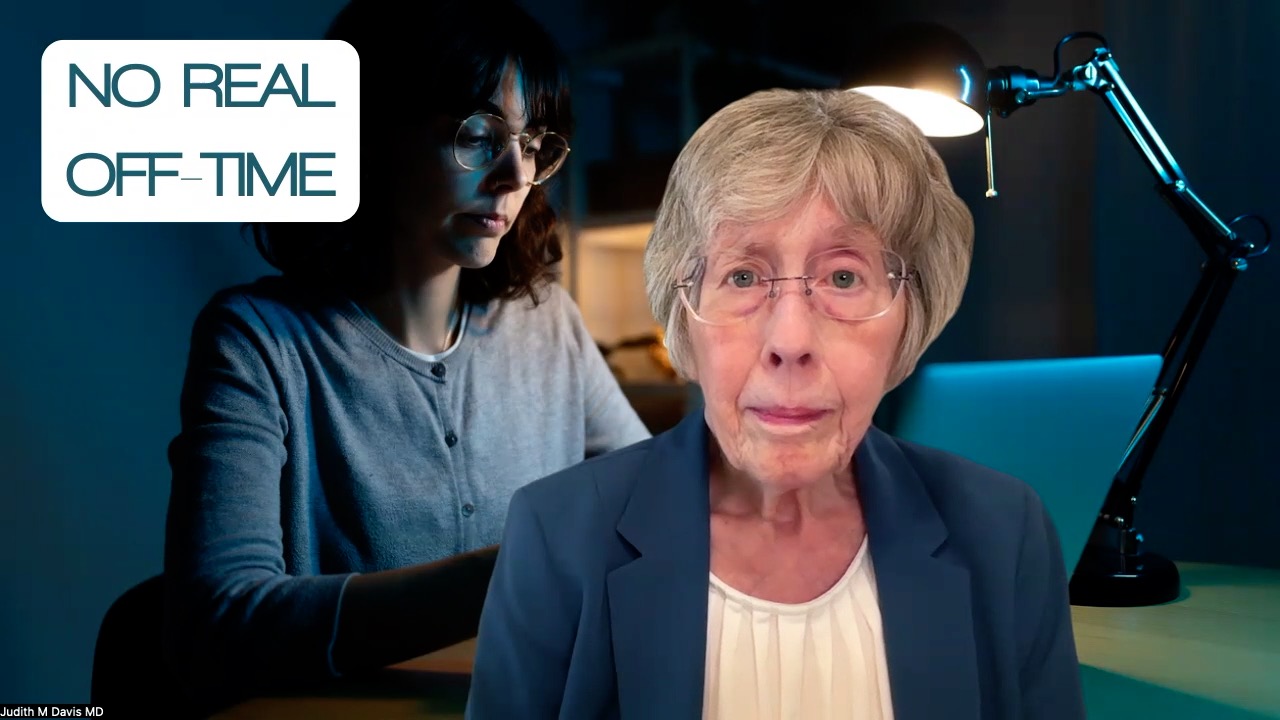
Over the past decade, work hasn’t just increased or intensified—it has changed shape. Recent workplace data show that for many people, the workday no longer has a clear beginning or a clear end. A large global survey found that about four out of ten professionals now check work email before six in the morning, and meetings scheduled after eight at night are becoming noticeably more common (yipes!). During a typical day, people are also receiving well over a hundred emails and messages, often with barely a pause between them.
Work is No Longer Confined to Work Hours
What’s interesting is that this doesn’t necessarily mean people are working nonstop, although they may be. It means work has become always potentially present.
Why Teachers Feel This Especially Strongly
And for teachers, this pattern tends to be even more pronounced. Surveys show that educators report less leisure time than many other professionals. Many schools now use online systems that post grades and messages in real time, which means school communication no longer has a natural pause.
Put together, these trends suggest something subtle but significant: even when nothing urgent is happening, the day doesn’t really feel over.
The Disappearance of a Clear Endpoint
In earlier times, work tended to have clearer boundaries. When you left the building, most obligations paused automatically. Now, responsibility comes home with you. If communication is possible, response is often implicitly expected. Even when nothing needs immediate action, the possibility of needing to respond remains present. This creates a new mental condition: not working, but still on standby.
What the Research Shows
Research shows that responding to work messages outside normal hours makes it harder for people to mentally detach from work because their minds remain partly engaged even when the workday is “officially” over. Importantly, this can happen even on lighter days, and even for people who genuinely like their work. This reduced detachment is linked with stress, emotional exhaustion, increased work-family conflict, sleep problems and burnout.
Why Typical Approaches Fall Short
Most attempted solutions focus on boundaries: turn off notifications, take breaks, schedule time away. These can help, but they don’t address the core issue: the mind never quite gets the signal that the day is done. Time off doesn’t fully register as finished time. People return from breaks rested in one sense, yet unchanged in another. This helps explain why so many professionals report feeling worn down. Because this problem is internal, external fixes will always be partial.
How an Inner Guide Can Help
It is possible, in fact easy, to create a new mental pathway that can reduce stress and uncomfortable emotions. I call it an Inner Guide. For this problem, having work always potentially present in your mind, adding to your stress and discomfort, an Inner Guide can help in three ways:
- Whenever you enter a self-hypnotic state, your Inner Guide is activated, and you experience a feeling of peacefulness and calm.
- It can enable you to set limits on your availability.
- It has the ability to blot out unwanted thoughts and feelings. We call it a "negative hallucination" when you don't perceive something that is there, as opposed to a "positive hallucination," during which you perceive something that isn't there.
Next Steps
You can create your own Inner Guide using the Stress-Free Formula, at
https://www.communityforwellbeing.com/the-stress-free-formula
If you already have an Inner Guide and would like to join our online Community for Well-Being, a community dedicated to supporting individuals who are using the Inner Guide in their lives, just email me at This email address is being protected from spambots. You need JavaScript enabled to view it. and I'll send you the link.